
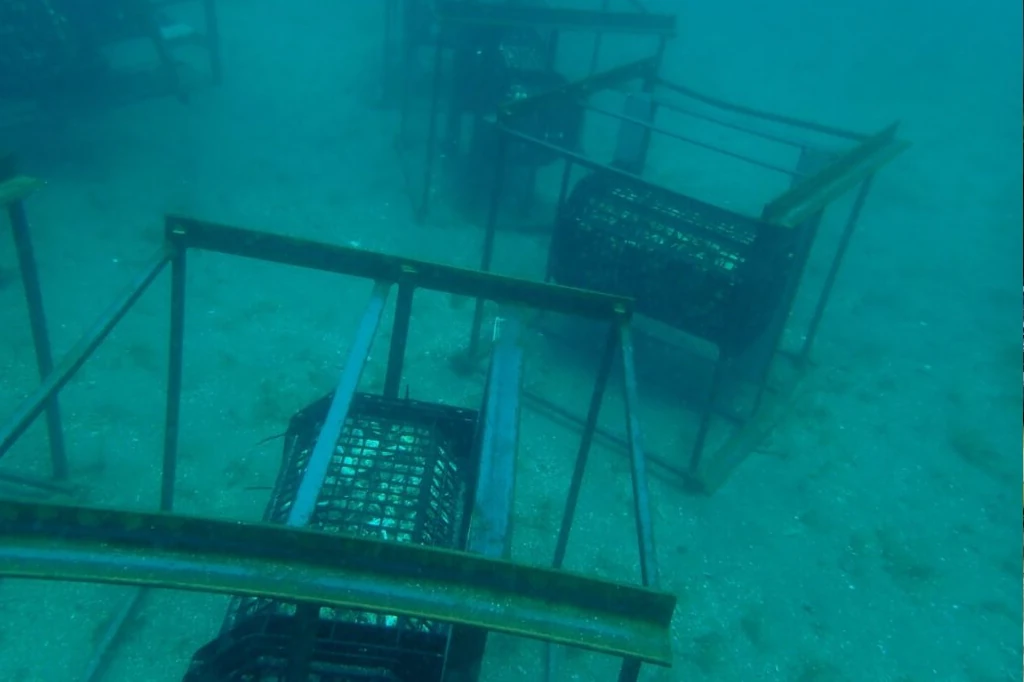
Daniel Madariaga. The artificial reef Shell Nurse, located in La Paz, Baja California Sur, has transformed the waters of the Gulf of California into a promising ecosystem. This project, inspired by Japanese models, has proven to be an essential pillar in the restoration and conservation of marine life in the region.
Shell Nurse is the result of a collaboration between the government, universities, public institutions, civil society organizations, and local fishermen. Together, they have addressed an urgent environmental problem: the excess of shells produced by mollusk fishing. This effort has allowed the transformation of a sandy seabed into a refuge rich in marine life.
Mollusk fishing in Baja California Sur generates nearly 100 tons of organic waste daily, most of it in the form of shells that were accumulating on the shores.
This excess was becoming a serious ecological problem. Through the implementation of Shell Nurse, the waste has been redirected to create a beneficial habitat for marine life.
The “Satoumi” Approach Projected in Mexico’s First Marine Ranch
The Japanese concept of “satoumi,” which promotes coexistence between humans and nature, underpins this project. Shell Nurse represents the first artificial reef of its kind outside of Japan, marking a significant step forward in the creation of Mexico’s first marine ranch, increasing biodiversity and ecosystem productivity.
Since its installation, a 30% increase in the population of marine species in the area has been recorded. Several studies have confirmed that the inclusion of natural shells in the structure of the reef attracts more fish, establishing an environment conducive to their development.
Sustainable Development and Growth for Local Communities
In addition to its ecological benefits, Shell Nurse has had a positive impact on the local economy. By strengthening the fish population, fishermen have seen an increase in their catch, leading to a greater income.
At the same time, educational programs have been implemented to raise community awareness about the importance of sustainability and the ocean’s conservation.
This Japanese model in the Gulf of California opens the door to future conservation initiatives, demonstrating that it is possible to harmonize human development, technological innovation, and environmental preservation.
Daniel Madariaga is a Mexican entrepreneur focused on sustainability and ecological innovation. A graduate of EGADE Business School, he leads projects in vertical farming, green mobility, and eco-friendly construction, while promoting recycling, food recovery, and responsible tourism.
👉 Check out this recommended article we think you’ll love: Whale watching in Baja California Sur: synergy between economic benefit and environmental conservation